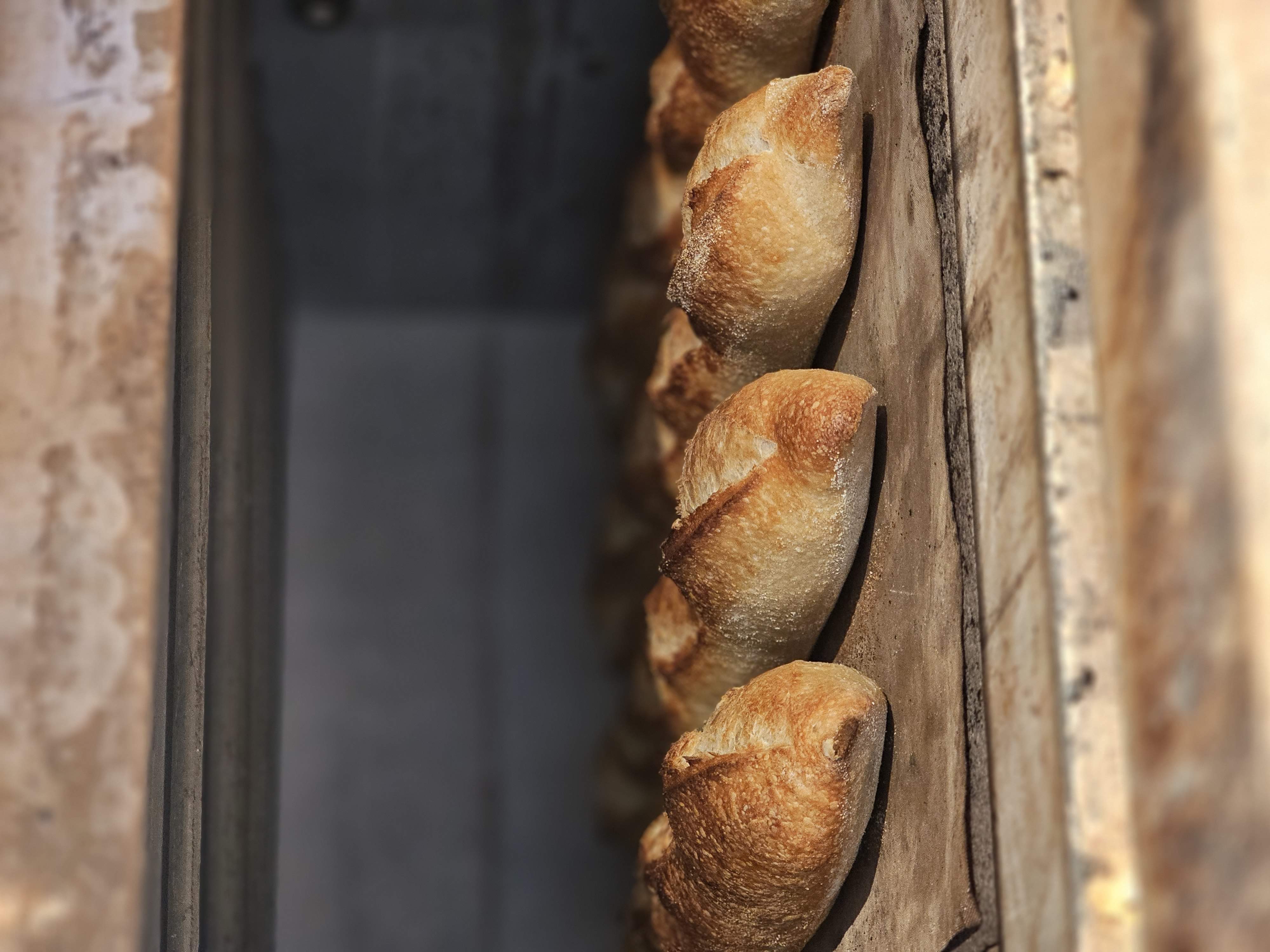
The Maillard Reaction: Crust Browning Chemistry
When you pull a perfectly baked sourdough from the oven—crackling crust, deep mahogany color, intoxicating aroma—you're witnessing chemistry in real time. That browning, that flavor, that aroma: none of it comes from caramelized sugar alone. It's the Maillard reaction, one of the most important chemical processes in bread baking.
The Maillard reaction isn't a single reaction—it's hundreds of sequential reactions happening simultaneously, starting from a deceptively simple pairing: a reducing sugar and a free amino acid. Understanding this process transforms how you bake. You'll know exactly why your crust color tells you whether your fermentation was long enough, why steam management matters, and why sourdough browns darker than commercial yeast bread despite having a lower pH.
What Is the Maillard Reaction?
In 1912, French chemist Louis-Camille Maillard observed that when he heated amino acids and reducing sugars together, they turned brown and smelled delicious. It took decades for chemists to understand why. By 1953, John Hodge mapped out the complete mechanism, revealing that this "browning reaction" actually unfolds in three distinct stages, each producing different compounds—some colorless, some aromatic, some responsible for that golden-brown hue.
The reaction starts with a simple attack: a free amino group (primarily from proteins) encounters a carbonyl group (from glucose, fructose, or maltose). They bond. This is the condensation phase—no color yet, no aroma yet. Just the formation of a Schiff base.
Three Stages of Browning
Stage 1: Condensation & Amadori Products (Room Temperature to 130°C)
The amine group attacks the carbonyl carbon, forming an N-glycosidic bond. This intermediate, called a Schiff base, is unstable. It rapidly rearranges into a more stable structure called an Amadori product (or ketosamines). Lysine, proline, arginine, and cysteine from the flour's proteins are the primary amino acid partners. At this stage, there is no browning and no aroma—the dough can undergo this reaction completely invisibly. The Amadori products are colorless.
Stage 2: Amadori Degradation & Volatile Compounds (130–160°C)
This is where the magic happens. Between 130 and 160°C, Amadori products break down into highly reactive carbonyl compounds: diacetyl, methylglyoxal, furans, pyrazines, pyranones, and volatile sulfur compounds. This is the aroma stage.
Two compounds deserve special attention. 2-acetyl-1-pyrroline and 2-acetyl-1,4,5,6-tetrahydropyridine are the signature molecules of fresh-baked bread—that nutty, toasted, warm aroma you smell when you cut into a loaf. Pyrazines contribute coffee and roasted notes. These compounds form most actively in the last 15–25 minutes of baking, precisely when the crust temperature exceeds 140°C and interior moisture has been driven off.
Notably, aromatic compound formation peaks at a crust temperature window of 150–160°C. Above 180°C, the reaction overshoots into pyrolysis (burning), producing acrid, bitter compounds. This is why oven temperature management matters so much: too hot, too fast, and you burn the aroma compounds before they form.
Stage 3: Polymerization & Melanoidins (160°C and above)
The reactive carbonyls don't stop at volatiles. They react with each other and with amino acids, forming larger and larger polymers called melanoidins. These polymers—ranging from 1,000 to 100,000 Daltons—are brown pigments. The longer the reaction proceeds, the darker the melanoidins, the darker your crust.
This is also why overbaking produces a very dark, nearly black crust: melanoidins continue to form and darken until the dough becomes rock-hard and the water content approaches zero.
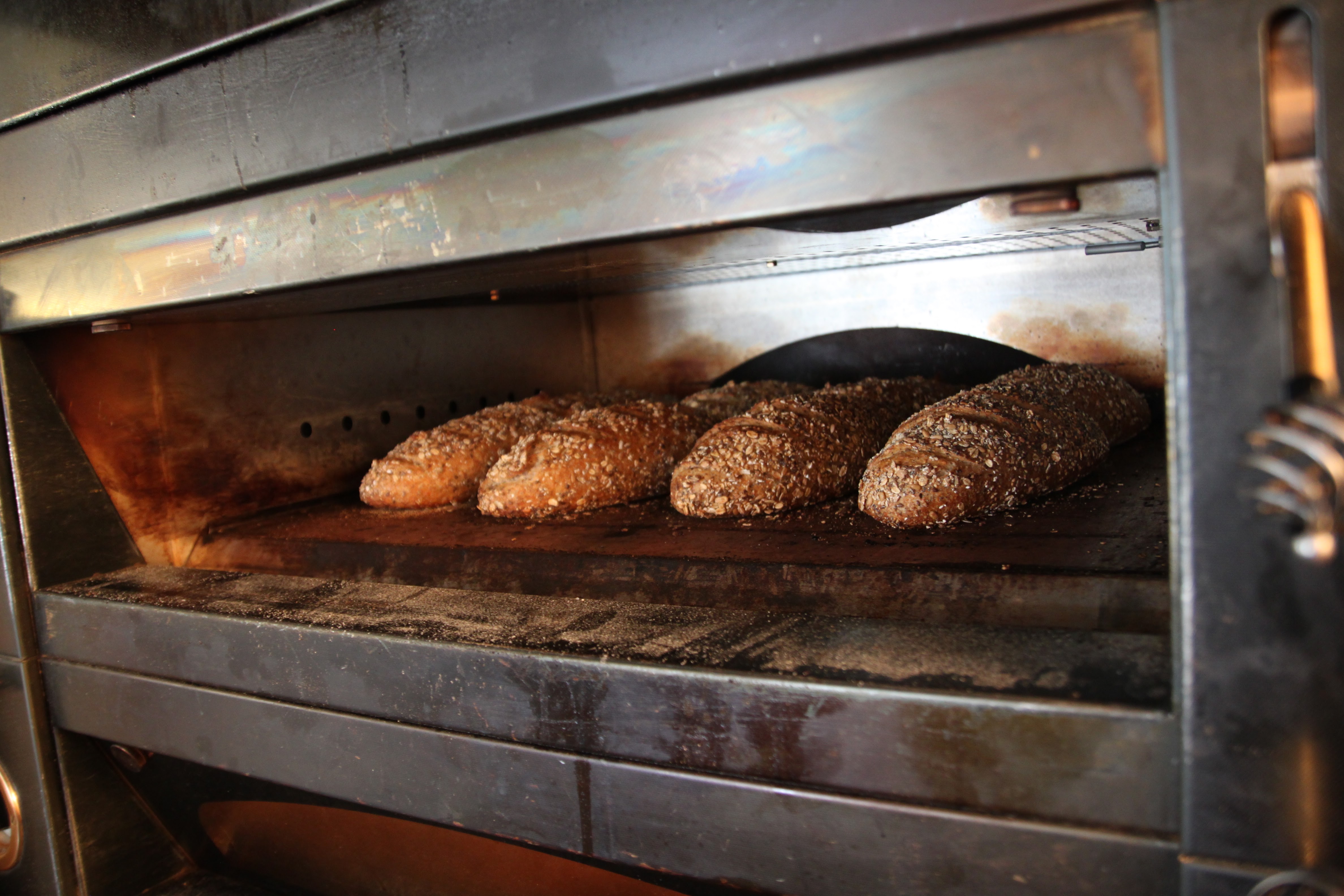
The Maillard reaction produces hundreds of aroma compounds in the last 15 minutes of baking
The Temperature Imperative
Temperature is the primary control lever. The Maillard reaction has an activation energy of 100–150 kJ/mol, which means its rate doubles (roughly) with every 10°C increase. At 130°C, it crawls. At 160°C, it sprints. This exponential temperature dependence is why a 20°C difference in crust temperature produces a visibly different crust color.
The practical optimum for sourdough browning is a crust temperature of 150–160°C, maintained for 15–25 minutes. Most home bakers achieve this with an initial 230–240°C oven temperature (first 30–40 minutes), then dropping to 220°C for the final 10 minutes. A digital probe thermometer ($10–15) is invaluable here: you can measure your actual crust temperature and adjust accordingly.
The Water Activity Sweet Spot
The Maillard reaction doesn't care about absolute moisture—it cares about water activity (aw), the fraction of water molecules available to participate in reactions.
The peak Maillard rate occurs at aw of 0.6–0.8. Why the range?
- Above aw 0.8: reactants are too diluted. The amino acids and sugars are swimming in water, colliding inefficiently. Browning is slow.
- Between 0.6–0.8: optimal. Reactants are concentrated enough to find each other quickly, but water is still present to facilitate rearrangements.
- Below aw 0.6: no molecular mobility. The dough becomes a glassy solid. Browning stalls.
In a baking sourdough, water activity tells a time story: it starts around 0.95 (wet dough), drops to 0.7–0.8 after about 10–12 minutes in the oven (peak browning window), and continues dropping below 0.6 as the crust hardens. This is precisely why steam first, then dry oven, produces the darkest crust: steam keeps the dough moist while the interior bakes, then you vent steam at minute 12–15 to drop aw into the optimal browning zone.
The Sourdough Paradox: Why Acidic Dough Browns Darker
Here's the puzzle: sourdough (pH 3.8–4.5) browns darker than commercial yeast bread (pH 5.5–6.0), despite the fact that the Maillard reaction runs 3–5× faster at higher pH.
Higher pH deprotonates the amino group (NH3+ → NH2), making it more nucleophilic and reactive. Chemistry textbooks predict that lowering pH should produce a pale crust. Yet sourdough bakers know the opposite is true.
The explanation is simple: reactant concentration overwhelms kinetics.
Over 18–24 hours of fermentation, sourdough's natural enzymes produce vastly more reactants:
- Reducing sugars: Amylases degrade starch to dextrins and maltose. Commercial yeast bread accumulates 0.3–0.5% maltose (dry weight). Sourdough: 1–2%. Yeasts consume some, but not all.
- Free amino acids: Proteases are 2–3× more active at pH 4.2–4.5 than at pH 5.5. After 24 hours: sourdough contains 150–300 mg free amino acids per kg flour vs. 50–100 mg in commercial yeast bread. Lysine—the best Maillard partner—is significantly elevated.
- Flavor precursors: Sourdough fermentation also produces acetaldehyde, ethanol, diacetyl, and acetic acid—all participants in the final flavor bouquet.
Net result: the Maillard reaction runs slower (lower pH), but with 2–3× more substrate. The curve is flatter but extends further. More melanoidins form. More aroma compounds develop. Darker, more complex crust.
Practical Implications for Your Oven
Oven Temperature Profile: Start at 230–240°C for the first 30–40 minutes, allowing the interior to reach 90°C and the crust to reach 160°C. Drop to 220°C for the final 10 minutes, monitoring for color. Total bake time: ~40–50 minutes for an 800–1000g loaf.
Steam Management: The first 12 minutes: sealed oven (Dutch oven, or steam injected). Minutes 12–25: vented to drop aw into the 0.6–0.8 zone. The crust will visibly deepen during these 13 minutes.
Temperature Measurement: Forget visual guessing. Buy a digital probe thermometer. Target: 94–96°C internal temp for white sourdough, 96–98°C for whole grain. Your crust color will correlate precisely to bake time once you know the internal temperature.
Fermentation Depth: Your crust color is a direct visual indicator of fermentation depth. Under-fermented dough (pale crust) = insufficient protease and amylase activity = few reactants = light browning despite correct temperature and time. Long, cool fermentation (deep crust color) = more enzymes working longer = more reducing sugars and amino acids = darker, more aromatic crust.
Additives for Browning: Adding milk or milk powder to your dough adds both lactose (a reducing sugar) and lysine (the primary Maillard amino acid). This accelerates browning significantly, producing a darker crust even with shorter fermentation. Professional bakeries use this trick.
Why Crust Color Matters More Than You Think
Crust color is not cosmetic. It's a biochemical readout of your entire process: fermentation time, enzyme activity, baking temperature, steam management, and flour quality all converge in that brown hue. A well-colored crust doesn't just look appealing—it indicates that the complex aroma compounds have formed, that the acidity has been properly developed, and that your bread will taste like sourdough, not like barely-risen commercial yeast bread.
The next time you pull a loaf from the oven, pause and really look at the color. If it's pale, ferment longer. If it's deep mahogany, you nailed the process. If it's black, your oven ran too hot. The Maillard reaction is your silent partner in the oven, translating time, temperature, and enzyme activity into flavor and aroma.