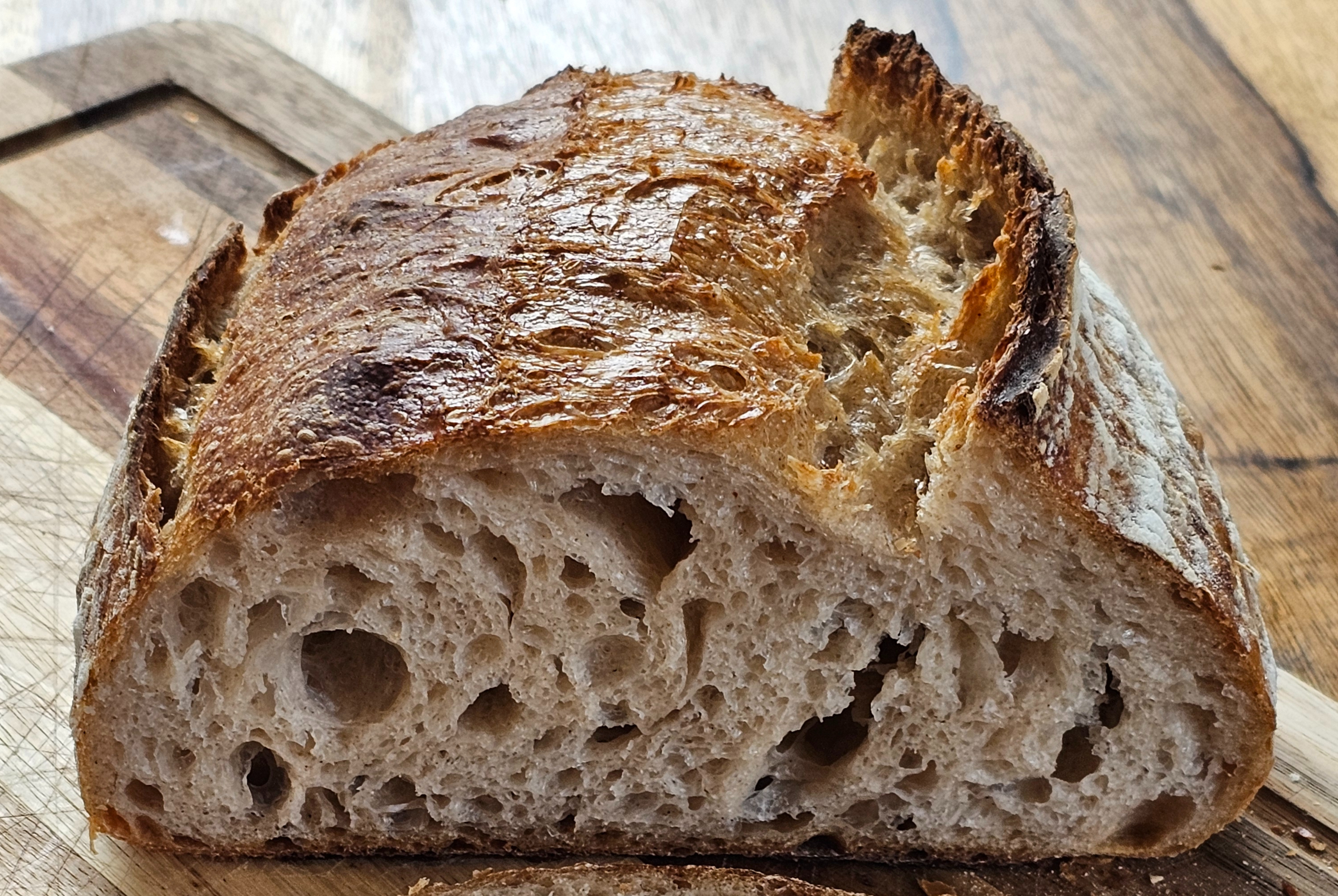
Starch Retrogradation: Why Bread Goes Stale
Bread doesn't go stale because it dries out—it goes stale because starch molecules reorganize at the molecular level. Discover the chemistry behind bread aging and why sourdough stays soft longer than commercial yeast bread.
What Is Retrogradation?
For decades, bakers assumed bread staled through moisture loss. A sealed, airtight loaf proved them wrong: it still hardens. The real culprit is starch retrogradation—the slow crystallization of starch molecules after baking.
Wheat flour is roughly 72–75% starch by weight. This starch exists in two molecular forms: amylose (a linear chain of glucose units) and amylopectin (a branched polymer). During baking, heat breaks down the starch's crystalline structure, and water molecules invade the granules in a process called gelatinization. After baking, these molecules don't stay "melted"—they gradually realign into semi-crystalline structures. This reorganization is retrogradation, and it's what makes fresh bread firm up over days.
Two Retrogradation Processes
Retrogradation happens in two distinct phases with very different timescales.
Fast Phase: Amylose Re-association (First 24 Hours)
Amylose molecules, being linear and relatively small, quickly associate with neighboring amylose chains. This happens within the first 24 hours after baking and is partially irreversible. This phase is responsible for setting the crumb structure—it's why fresh bread, even at room temperature, noticeably firms up overnight. You can feel this change by the morning after baking.
Slow Phase: Amylopectin Re-association (Days 2–7)
Amylopectin, the branched starch component, re-crystallizes much more slowly. The short-chain branches (14–20 glucose units long) gradually form double-helix crystalline structures. This process dominates the second through seventh day of aging and is the main driver of ongoing bread hardening. It's also more thermally reversible than amylose.
Crumb structure after proper gelatinization and cooling
Temperature: The Critical Control Point
Retrogradation rate is exquisitely sensitive to temperature—in ways that surprise most bakers.
Practical numbers tell the story: a sourdough loaf at 20°C (room temperature) loses approximately 50% of its crumb softness in 48 hours. The same bread stored at 4°C (in a refrigerator) loses that same 50% softness in just 24 hours—twice as fast. Worse still, at 10°C and above, retrogradation slows significantly. Below -18°C (freezer), molecular motion nearly stops, and retrogradation essentially halts.
The implication is stark: never store bread in the refrigerator if you want it to stay soft. The refrigerator is a staling accelerator, not a preservative.
-18°C (freezer): retrogradation halted ✓
20°C (room temp): moderate retrogradation
4°C (fridge): fastest retrogradation ✗
0°C (just above freezing): still fast
Why Sourdough Stays Fresh Longer
Properly made sourdough typically stays soft and fresh for 3–4 days at room temperature, while a direct yeast bread (using commercial yeast alone) stales noticeably within 1–2 days. Two mechanisms explain this dramatic difference.
Mechanism 1: Low pH Retards Crystallization
Sourdough fermentation produces both lactic acid and acetic acid from lactic acid bacteria (LAB). This lowers the dough pH from about 5.8–6.0 (commercial yeast bread) to 4.2–4.5 (sourdough). At low pH, the amylopectin retrogradation process creates less ordered, less densely packed crystalline structures. In other words, the starch molecules re-align more slowly and into softer configurations. The result: a crumb that stays tender days longer.
Mechanism 2: Bound Water from Arabinoxylans
The sourdough fermentation environment (low pH, long timespan) causes the release of arabinoxylans—complex carbohydrates originally bound to the cell walls of wheat flour. Arabinoxylans are remarkable hydrocolloids: a single gram can bind up to 10 grams of water. This bound water is much less "available" for participating in starch retrogradation. More bound water, less free water accelerating recrystallization. The net effect: softer, fresher crumb for longer.
Flour Type and Retrogradation Rate
Not all sourdough loaves stale at the same rate, even under identical fermentation and storage conditions. Flour composition changes the retrogradation timeline in two measurable ways: bran content and starch damage from milling. Whole wheat and high-extraction flours contain bran particles that physically disrupt the continuous starch-gluten network, creating discontinuities where crystallizing starch chains have less opportunity to align into large ordered domains. The practical effect is that whole wheat sourdough often feels like it firms up less dramatically than a white flour loaf, even though the underlying amylopectin recrystallization chemistry is identical.
Milling also damages a fraction of starch granules mechanically, and damaged starch absorbs water far faster than intact granules—up to twice its own weight versus roughly 30% for undamaged starch. Higher damaged-starch flours (common in stone-ground and whole-grain products) gelatinize more thoroughly during baking and tie up more water in the crumb structure. That extra bound water behaves similarly to the arabinoxylan mechanism described above, giving these flours a modest additional resistance to firming, on top of whatever benefit sourdough fermentation already provides.
The Role of Fat and Emulsifiers: Amylose-Lipid Complexation
Enriched doughs—brioche-style levain, milk breads, pan loaves with added butter or oil—stale differently than lean sourdough. Fats and monoglycerides form helical inclusion complexes with amylose, in which the amylose chain wraps around the lipid molecule's hydrocarbon tail. An amylose chain locked inside one of these complexes cannot re-associate with neighboring amylose chains, which physically blocks the fast retrogradation phase described earlier. This is precisely why commercial sliced bread almost always contains added mono- and diglycerides: they are inexpensive, food-safe anti-staling agents that exploit this same chemistry.
For home and craft bakers, the practical takeaway is that a small addition of butter, oil, or egg yolk (naturally rich in lecithin, another amylose-complexing lipid) measurably extends softness, independent of sourdough's own pH and arabinoxylan mechanisms. A lean, high-hydration country sourdough and an enriched sourdough brioche are staling through partially different chemical pathways—which is why blending an enrichment (even 5–8% fat by flour weight) onto an already well-fermented sourdough base produces the longest-lasting soft crumb of any combination.
Reversing Staling: Reheating Protocol
Here's the good news: amylopectin retrogradation is thermally reversible above 60°C. The heat disrupts the semi-crystalline structures, and the starch granules partially absorb water again, temporarily reversing the staling effect.
Reheating protocol: Take a frozen or staled loaf (700g), wet the entire crust under running water for 5 seconds on each side, then place in a 190°C (375°F) oven for 10 minutes. The result: roughly 85% crumb quality restoration. The remaining 15% loss is irreversible—those are volatile bread aromatics that have already escaped and cannot be reabsorbed.
This creates a powerful economic opportunity for bakeries: instead of discarding unsold bread, freeze whole loaves at end of day, then thaw and reheat the next morning per this protocol. The reheated bread is actually higher quality—softer, fresher—than bread that merely sat at room temperature and aged naturally.
Practical Takeaways for Home Bakers
- Store at room temperature or freeze; never refrigerate. The fridge accelerates staling by 2×.
- Sourdough's softness advantage comes from low pH and arabinoxylans, not just flavor. Use long, cold fermentation to maximize acid production.
- Stale bread isn't ruined. Reheating per protocol restores ~85% of crumb quality.
- Hydration matters. Higher hydration (80%+) creates more bound water through better gluten-starch interactions, slowing retrogradation.
Frequently Asked Questions
Does toasting stale bread work as well as the reheating protocol?
Toasting only reheats the surface—by the time the crust reaches toasting temperature, the interior crumb is still well below the 60°C threshold needed to reverse amylopectin retrogradation. Toasting restores crust crispness and aroma but does almost nothing for a dense, stale interior. The whole-loaf reheating protocol described above (wet crust, 190°C oven, 10 minutes) is the only method that reliably reverses retrogradation through the full crumb, not just the surface.
Why does bread stored in a paper bag or bread box stay softer than bread wrapped in plastic?
This is a common misconception worth correcting directly: bread in a paper bag or open bread box actually stales chemically at the same underlying rate as bread in plastic—retrogradation depends on temperature and starch chemistry, not on the wrapping. What differs is moisture loss: paper lets the crust dry out and stay crisp, so the loaf feels less unpleasant even as the crumb underneath is retrograding at the same rate as it would in plastic. If you specifically want to slow crumb staling rather than manage crust texture, temperature (room temp or freezer, never the fridge) is the variable that actually matters.
Sources
1. Belitz, H. D., Grosch, W., & Schieberle, P. (2009). Food Chemistry (4th ed.). Springer-Verlag.
2. Cauvain, S. P. (2015). Technology of Breadmaking (3rd ed.). Springer.
3. Gray, J. A., & BeMiller, J. N. (2003). Bread staling: molecular basis and control. Comprehensive Reviews in Food Science and Food Safety, 2(1), 1–21.
4. Courtin, C. M., & Delcour, J. A. (2002). Arabinoxylans and endoxylanases in cereals. Journal of Cereal Science, 35(3), 225–243.
5. Schiraldi, A., & Fessas, D. (2001). Mechanism of staling: an overview. In Bread Staling (pp. 1–22). CRC Press.