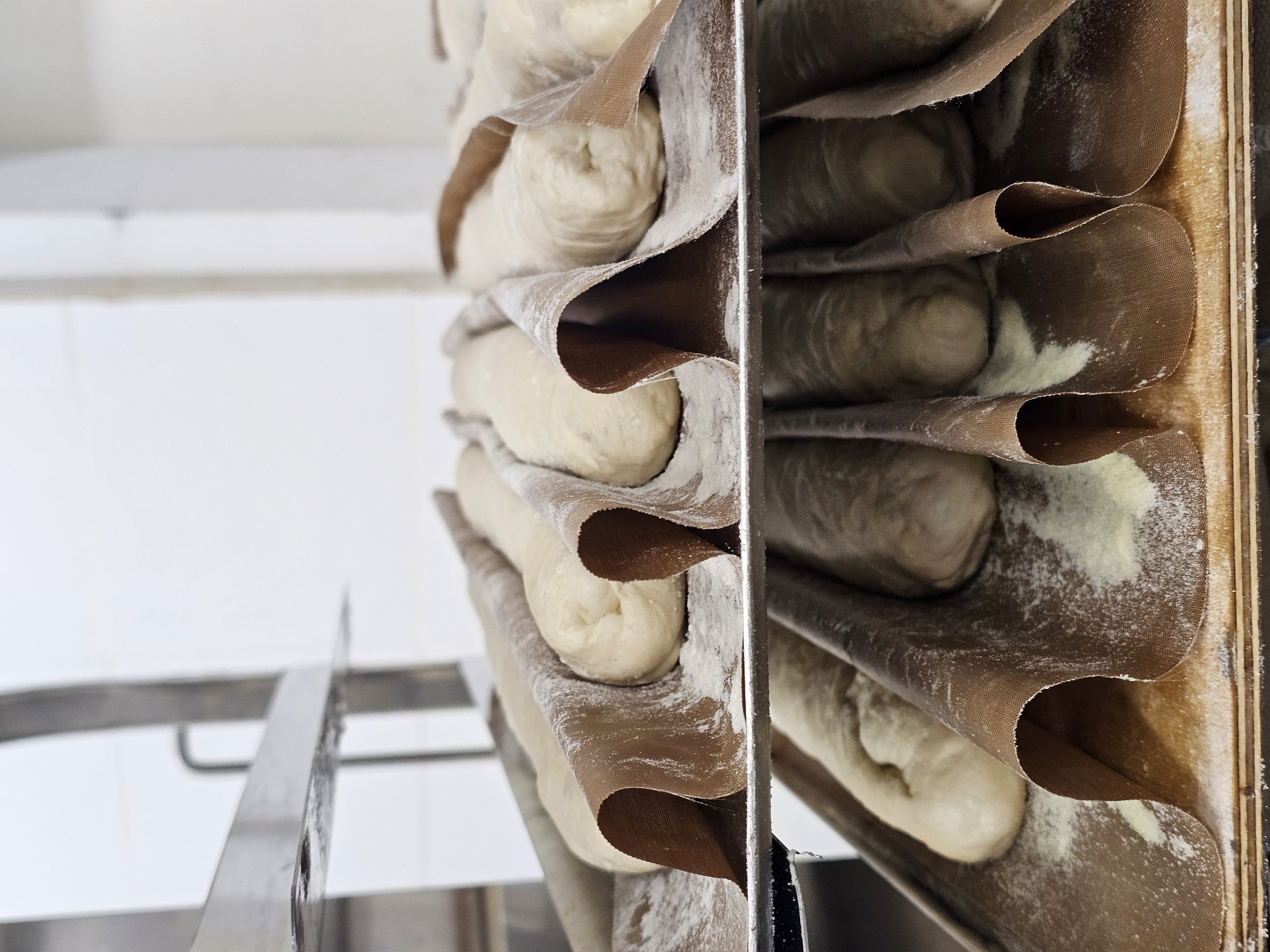
Oven Spring: The Physics of the First 15 Minutes
Oven spring—the dramatic volume expansion that happens in the first 12–15 minutes of baking—is where the final shape and texture of your bread are determined. It's not a single physical process but a cascade of simultaneous phase transitions. Understanding these minutes transforms how you design your dough and control your bake.
What Is Oven Spring?
Oven spring is the increase in loaf volume from the moment you place the dough in the oven until the crust hardens and the crumb structure sets permanently. Most bakers target 20–30% volume expansion. This happens in a narrow window of time and temperature, driven by overlapping but distinct physical phenomena.
The "spring" is not a single mechanism—it's an orchestrated sequence of phase transitions. Gas expands, water evaporates into steam, starch granules swell and gelatinize, gluten denatures, and enzymes become active or deactivate. All of this unfolds in roughly 12 minutes. Understanding the timeline of these events lets you manipulate dough hydration, proofing, and oven temperature to maximize height without collapsing the structure.
Minutes 0–4: The Gas Expansion Phase
When dough enters a hot oven (typically 235–250°C), the immediate temperature jump accelerates diffusion rates and gas expansion according to the ideal gas law. However, this simple mechanical expansion is far less important than what's really happening.
CO₂ Release From Solution
Sourdough fermentation at pH 4.2–4.5 creates a slightly acidic aqueous environment in the dough. Under these conditions, significant CO₂ is dissolved in the dough water as dissolved carbonate. As oven temperature rises from 25°C to 50°C, Henry's law governs gas solubility: the solubility of CO₂ in water roughly halves across this range. Dissolved CO₂ rapidly comes out of solution and joins existing gas bubbles.
This is more impactful than simple thermal expansion of existing air. The ideal gas law says heating air from 25°C to 60°C in the dough core delivers only about 12% volume expansion. Releasing dissolved CO₂, by contrast, adds gas molecules directly—a more dramatic effect.
Minutes 2–6: Steam Generation (The Dominant Phase)
The real engine of oven spring is steam. One gram of liquid water converts to 1,673 cubic centimeters of steam at standard atmospheric pressure—a volume multiplication of 1,673×. Even if only a few percent of the dough's water content converts to steam in the first few minutes, the volumetric effect is enormous.
As oven temperature rises into the 60–90°C range, water in the dough evaporates into steam. This steam remains trapped inside the gluten network and existing gas bubbles, expanding them. A 20–30% loaf volume increase in 4–6 minutes is almost entirely due to steam generation and entrapment, not air expansion.
This temperature window (60–90°C) overlaps crucially with starch gelatinization onset (58–85°C). As starch granules begin to swell and absorb water, the dough viscosity increases, creating a semi-solid matrix that traps the expanding steam bubbles. This mutual reinforcement—steam pushing out, starch setting in—drives oven spring.
Minutes 4–8: Enzyme Activity and the Viscosity Window
Alpha-amylase enzymes naturally present in flour peak in activity at 60–75°C. These enzymes cleave starch molecules into shorter chains, temporarily lowering dough viscosity. This creates a critical window: just before gelatinization fully solidifies the structure, the dough becomes slightly more fluid, allowing gas bubbles to expand more freely.
Over-proofed dough enters the oven with depleted natural amylase (consumed during long fermentation) and weak gluten networks. Without amylase activity to create this brief "mobile" window, gas expansion is constrained, and the loaf doesn't spring well. The bread stays flat.
Sourdough's low pH (4.2–4.5) is critical here. Lactic and acetic acids strengthen hydrogen bonds in gluten proteins, making the gluten network more elastic and resilient. Even as alpha-amylase temporarily lowers viscosity, the acidified gluten can still contain the expanding steam without collapsing. Commercial yeast bread, at pH 5.8–6.0, has weaker acid-reinforced gluten and is more susceptible to over-proofing.
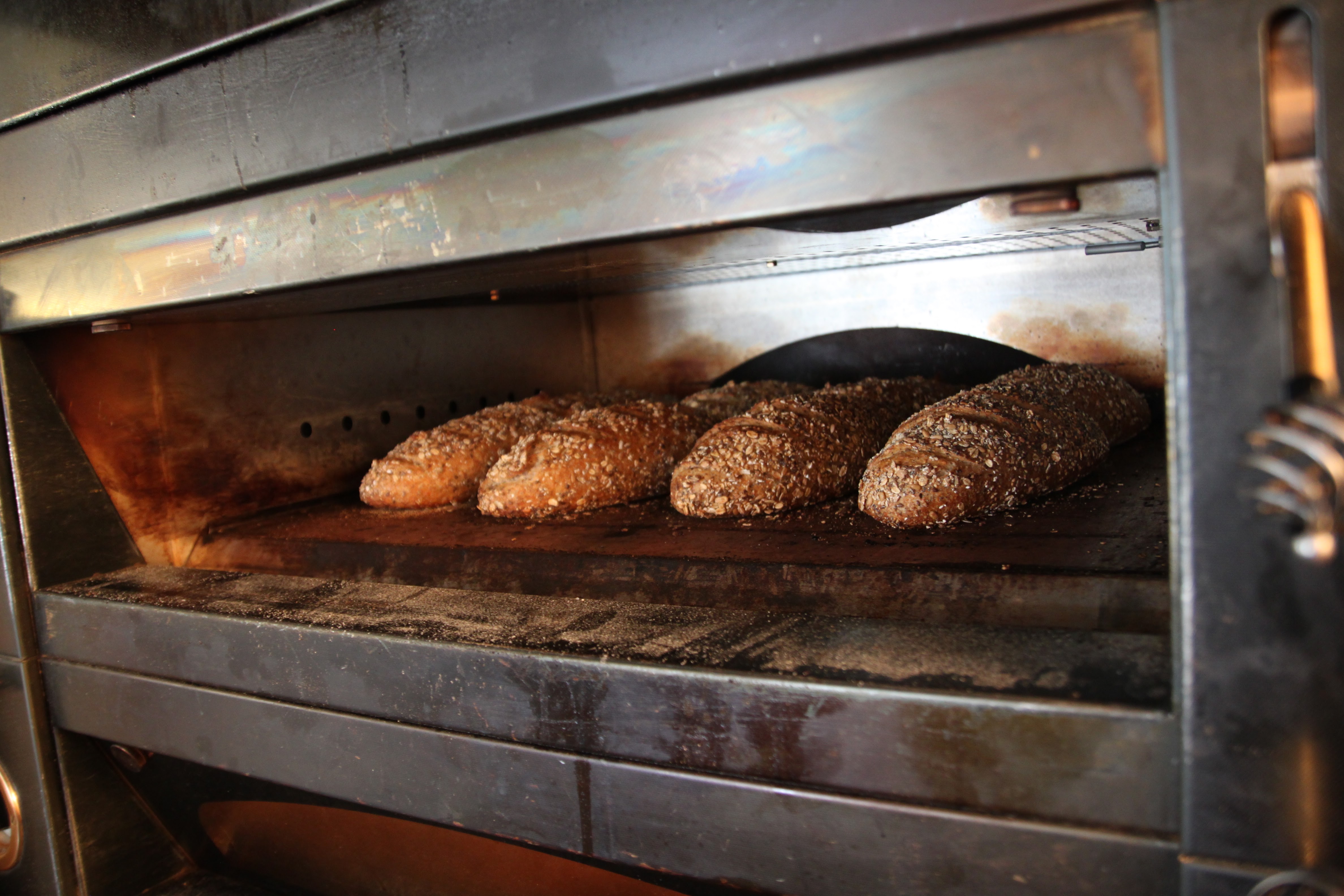
Crust formation and oven spring in a Dutch oven
Minutes 6–10: Protein Denaturation and Structure Fixation
As the dough core temperature climbs toward 75–85°C, gluten proteins denature irreversibly. The gluten matrix, which has been stretching with the expanding steam, now hardens into its final form. Disulfide bonds between glutenin subunits re-form in their new, expanded configuration, locking the structure in place.
By the time the dough core reaches 90°C, all oven spring has ceased. The crumb structure is thermally fixed and cannot expand further, no matter what happens in the oven afterward. This is why proofing control is so critical: if your dough is under-proofed (only 10–15% pre-oven rise), it can still gain 20–30% in the oven. If it's over-proofed (80–100% rise), the gluten is already stretched near its limits, and oven spring is minimal.
Steam Management: Sealed vs. Open Baking
Steam control is the difference between a tall, open crumb loaf and a dense, flat one.
Dry oven (no steam): The dough's outer surface dries in 60–90 seconds. Crust sets immediately. Interior steam is now trapped behind a hardened surface, so bubbles can't expand further. Result: dense, small loaf.
Humid oven (Dutch oven or steam injection): Steam keeps the dough's surface near 100°C (evaporative cooling from latent heat). The surface stays pliable for 12–15 minutes instead of 90 seconds. Interior steam can continue pushing outward the entire time. Remove the lid/steam after 12–15 minutes; the crust then dries and browns via Maillard reactions at high temperature. Result: tall loaf with open crumb.
Practical Design Rules
Proofing Target
Target 30–50% volume increase during final proofing, not 80–100%. This leaves "oven spring headroom." A loaf that has already doubled before going into the oven has exhausted its gluten extensibility and enzymatic reserves. It will collapse or barely expand in the oven. A loaf at 40% rise still has elastic potential to capture oven spring.
Temperature Profile
Start at 235–250°C with steam to maximize the window where steam and starch gelatinization align. After 12–15 minutes (crust fully set and browning begins), reduce to 220°C for the rest of the bake. This prevents over-browning while the interior continues to bake.
Baking Surface
A hot baking stone or steel under the dough creates a steep temperature gradient: the bottom of the loaf heats rapidly while the top rises more slowly. This bottom-to-top heat gradient generates internal steam more forcefully and drives oven spring higher than a loaf baked on a regular shelf.
Why Over-Proofing Kills Oven Spring
An over-proofed dough has depleted its natural enzyme reserves (amylase is consumed during fermentation), weakened its gluten structure (extended fermentation softens protein networks), and is physically at the edge of collapse. When it enters the oven:
- No amylase activity to create the viscosity dip that allows expansion
- Weakened gluten can't contain the pressure of expanding steam—the loaf spreads sideways instead of up
- Gas bubbles are already large and thin-walled; they collapse rather than expand further
Result: a flat, dense loaf with a gummy interior. The fix is not a hotter oven—it's tighter proofing control beforehand.
The Role of Fermentation pH
Sourdough's lower pH (4.2–4.5 vs. 5.8–6.0 for commercial yeast) strengthens gluten via acid-catalyzed hydrogen bonding. This is especially important during the viscosity window (minutes 4–8) when alpha-amylase temporarily lowers dough stiffness. Acid-fortified gluten can still hold its shape against expanding steam. Neutral-pH dough is more prone to over-expansion and collapse.
Summary: The Oven Spring Timeline
Minutes 0–2: Oven temperature spikes; dissolved CO₂ comes out of solution; initial gas expansion begins.
Minutes 2–6: Steam generation dominates. Starch begins gelatinizing. Dough viscosity increases. 70–80% of final volume gain happens here.
Minutes 6–10: Alpha-amylase peaks; temporary viscosity dip allows final bubble expansion. Gluten denatures and hardens. Crust forms and begins browning.
Minutes 10–12: Core temperature reaches 90°C. Gluten fully set. All oven spring ceases.
Minutes 12–15+: Interior continues baking. Crust browns via Maillard reactions.
Sources
1. Belitz, H. D., Grosch, W., & Schieberle, P. (2009). Food Chemistry (4th ed.). Springer-Verlag.
2. Cauvain, S. P. (2015). Technology of Breadmaking (3rd ed.). Springer.
3. Mondal, A., & Datta, A. K. (2008). Bread baking—a review. Journal of Food Engineering, 86(4), 465–474.
4. Wagner, M. J., Morey, R. V., & Imdieke, R. E. (2007). Water transport in bread during baking. Journal of Food Engineering, 78(4), 1217–1227.
5. Patel, M. J., Halley, P. J., & Bason, M. (2005). Impact of different baking processes on bread firmness and water content. Journal of Cereal Science, 41(1), 104–113.