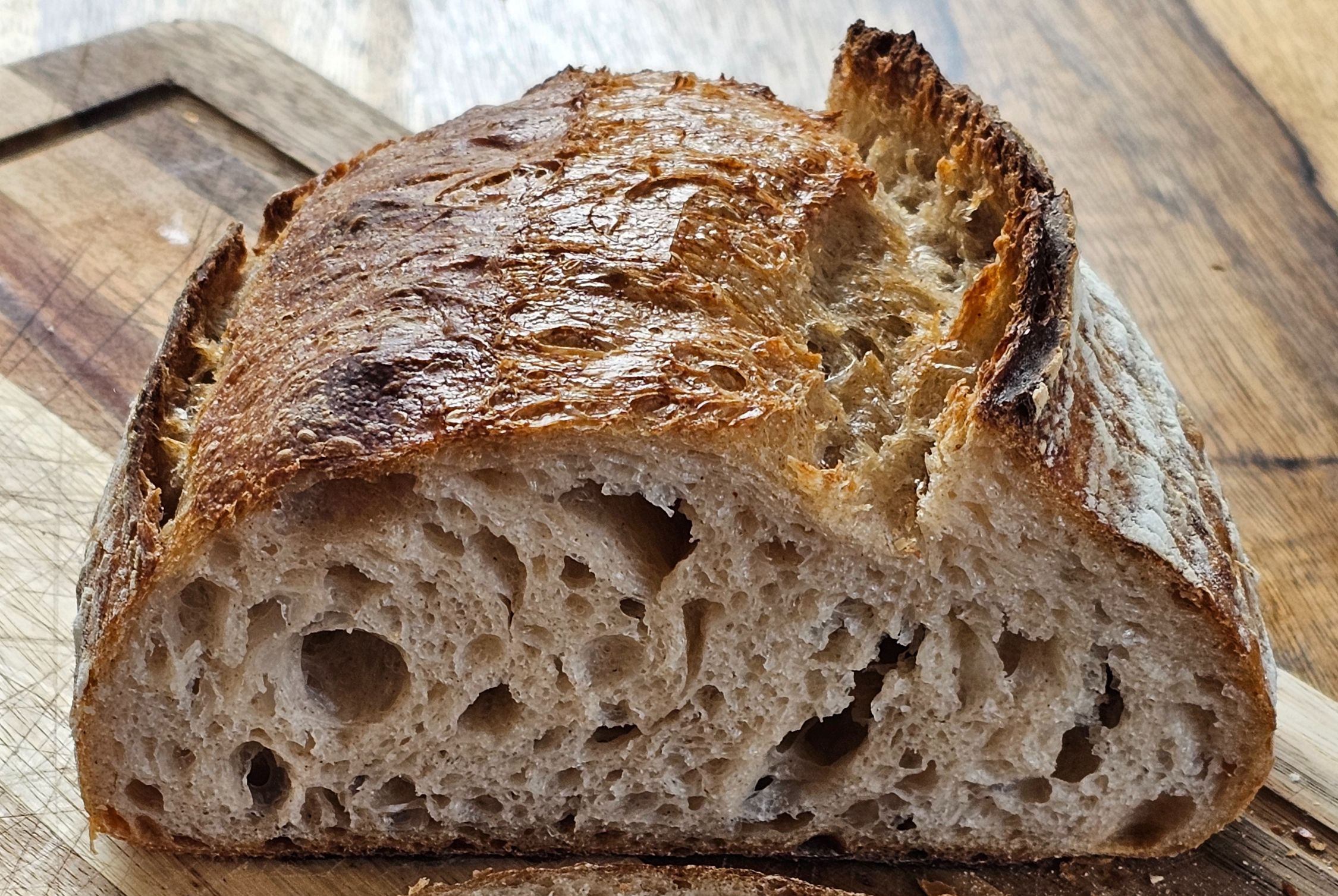
Bassinage: Two-Stage Hydration
The physics of adding water mid-mix to achieve high-hydration doughs without gluten collapse
Bassinage is a fundamental technique in sourdough baking that solves one of the baker's central challenges: how to incorporate enough water for an open crumb and extensible dough without destroying the gluten network. The word, borrowed from French baking terminology, refers specifically to adding water *after* the initial mixing has begun—a deceptively simple action with profound physics behind it.
The classical sourdough formula often aims for 75–85% hydration, yet mixing all the water at once at these levels creates a sticky, slack dough where the gluten network cannot form properly. Bassinage changes this by splitting hydration into two distinct phases, each optimized for different stages of gluten development.
The Problem: High Hydration and Network Collapse
To understand why bassinage is necessary, we must first examine what happens when you add all the water at once to high-hydration doughs.
Glutenin Hydration Kinetics
Proteins in flour hydrate at different rates. Glutenin, the primary structural protein in bread, absorbs water slowly—typically requiring 8–15 minutes to reach equilibrium hydration. In contrast, starch granules and other flour components absorb water nearly instantaneously.
When you mix all 85% hydration water at once, the result is a dough with excess free water—water not yet bound to gluten proteins. This free water acts as a lubricant, preventing the disulfide bonds (S-S bridges) from forming between glutenin molecules. Without these cross-links, the gluten network cannot develop the strength needed to trap gas bubbles or provide structure.
Storage Modulus Collapse
Rheologists measure gluten network strength using a parameter called storage modulus (G'), measured in pascals (Pa). A well-developed gluten network maintains G' above 1500 Pa; a strong network reaches 3000 Pa or higher.
When dough hydration exceeds 75% all at once, storage modulus drops dramatically—often below 500 Pa—rendering the dough unable to be shaped or hold gas. The dough becomes slack, soupy, and unworkable. Even after extended mixing, the excess free water interferes with proper network formation.
Building gluten network during the first hydration phase — a crucial foundation for accepting additional water
How Bassinage Works: Two-Phase Hydration
Phase 1: Initial Hydration (65–70%, 8–12 minutes)
The first phase begins with a reduced hydration level—typically 65–70% of flour weight. At this lower hydration, water is immediately available for glutenin hydration without creating excess free water. The protein concentration per unit volume is higher, which paradoxically speeds disulfide bond formation.
During these 8–12 minutes, the dough is mixed continuously or in rest intervals (for autolyse variations). The gluten network develops visibly—the dough becomes smoother, less sticky, and more cohesive. A window pane test at the end of Phase 1 should show a translucent membrane without tearing.
The biochemistry here is critical: glutenin is actively cross-linking, forming networks that will soon serve as the scaffold for the additional water. Arabinoxylans—soluble pentosans in flour—begin absorbing water, but they remain unsaturated; they have capacity to absorb 10–15 times their dry weight in water.
Phase 2: Bassinage (2–3 additions of 30–60 ml each, 2–5 minutes total)
Once the Phase 1 network is stable, water is added in small increments—typically 2–3 additions of 30–60 ml each, with brief mixing (20–30 seconds) between additions. This is bassinage proper.
The key insight: water added in Phase 2 is absorbed as *bound water* into the existing network, not as free water flooding it. The arabinoxylans that were only partially hydrated in Phase 1 now absorb the additional water quickly and completely. The already-formed gluten network provides the structural framework—think of it as a sponge with pre-existing channels.
Each addition of water is rapidly absorbed. The dough increases in extensibility without collapsing in strength. A dough that was 70% hydration and firm in texture becomes 85% hydration and silky, yet capable of being shaped and fermented.
Hydration Kinetics in Detail
Starch vs. Protein Absorption
Starch granules in flour absorb water over milliseconds, reaching saturation quickly. They don't require the extended hydration time that proteins do. This is why adding too much water at once creates such slack dough—the starch is already fully hydrated, but the gluten proteins are still competing for water molecules.
Bassinage leverages this difference. In Phase 1, water is distributed among starch and the beginning stages of protein hydration. In Phase 2, the bulk of water is absorbed by proteins and arabinoxylans that are now "ready" to accept it, having been primed in Phase 1.
Temperature Control
Mixing generates friction heat, which accelerates fermentation and can lead to uneven gluten development in hot kitchens. Phase 1 mixing is shorter in bassinage protocols than in traditional full-hydration mixes, reducing heat buildup.
Furthermore, Phase 2 water can be chilled (4–6°C) to offset friction heat. Each 30 ml addition of cool water can lower dough temperature by 2–3°C—a significant advantage during summer baking or in warm kitchens. This thermal control preserves the ideal temperature range (26–28°C) for bulk fermentation.
When NOT to Use Bassinage
Bassinage is powerful, but it is not universally applicable. Consider alternatives in these cases:
Weak Flour (W < 180 Extensograph units, protein < 11%)
Weak flours have insufficient glutenin concentration to form the robust network needed for Phase 1. Even at 65–70% hydration, weak flour will struggle. Consider longer autolyse (30–60 minutes) or different flour instead.
Low Hydration Doughs (< 72%)
Bassinage is unnecessary below 72% hydration. Traditional mixing at moderate hydration is simpler and equally effective. Reserve bassinage for when you specifically want to reach 80%+ hydration.
High Whole Wheat Content (> 50%)
Bran particles mechanically cut the gluten network, limiting maximum usable hydration regardless of technique. For whole wheat loaves, extend the autolyse (30–60 minutes) to allow full bran hydration, but don't rely on bassinage alone to rescue high-extraction doughs.
Sourdough-Specific Considerations
Starter Timing
The sourdough starter (levain) should always be incorporated in Phase 1, not Phase 2. Why? The starter introduces both water and active microorganisms that participate in early network development and fermentation. Adding it in Phase 2, after gluten formation, dilutes its beneficial effect and complicates hydration calculations.
Fermentation Monitoring
Sourdough fermentation is dynamic—bacteria and yeast produce gas and organic acids throughout bulk fermentation. These byproducts change the dough's viscoelastic properties in ways that synthetic (commercial yeast) doughs don't.
Track pH drop carefully. Target a pH drop of 0.4–0.6 units from start of bulk to end. In high-hydration bassinage doughs, this pH change may occur more rapidly due to increased microbial activity in the wetter environment. Adjust bulk fermentation time accordingly; you may need 4–5 hours instead of 6–8.
Phase 2 Timing in Sourdough
Phase 2 in sourdough should be shorter than in commercial yeast breads—aim for 2–3 minutes rather than 5 minutes. The starter is already generating gas and acidity; extended Phase 2 mixing risks over-oxidizing the dough and disrupting early fermentation.
Practical Protocol
Phase 1: Mix flour (100%), water (70%), and salt (2%) for 8–12 minutes on medium speed (or 4–6 minutes if by hand with stretch-and-fold intervals). Dough should be smooth, slightly firm, and pass the window pane test.
Phase 2: Add 30–40 ml of cool water. Mix for 20–30 seconds. Rest 30 seconds. Repeat 2–3 times until all additional water is incorporated. Final hydration: 85%.
Fermentation: Begin bulk fermentation immediately after Phase 2. In sourdough, monitor pH and dough rise; adjust fermentation time based on actual readiness, not clock time.
Sources
- Belitz, H. D., Grosch, W., & Schieberle, P. (2009). Food Chemistry (4th ed.). Springer.
- Wieser, H. (2007). Chemistry of gluten proteins. Food Microbiology, 24(2), 115–119.
- Dobraszczyk, B. J., & Morgenstern, M. P. (2003). Rheology and the breadmaking process. Journal of Cereal Science, 38(3), 229–245.
- Cauvain, S. P., & Young, L. S. (2015). Technology of Breadmaking (3rd ed.). Springer.
- Courtin, C. M., & Delcour, J. A. (2002). Arabinoxylans and endoxylanases in wheat flour bread-making. Journal of Cereal Science, 35(2), 225–243.